About Mizoram -> People of Mizoram
Perching on the high hills of North Eastern corner, Mizoram is a storehouse of natural beauty with its endless variety of landscape, hilly terrains, meandering streams deep gorges, rich wealth of flora and fauna. Flanked by Bangladesh on the west and Myanmar on the east and south, Mizoram occupies an importance strategic position having a long international boundary of 722 Kms.World-renowed for their hospitality, Mizos are a close-knit society with no class distinction and no discrimination on grounds of sex. The entire society is knitted together by a peculiar code of ethics 'Tlawmngaihna' an untranslatable term meaning on the part of everyone to be hospitable kind, unselfish and helpful to others.
The Land :
Mizoram is a mountainous region which became the 23rd State of the Union in February 1987. It was one of the districts of Assam till 1972 when it became Union Territory. Sandwiched between Myanmar in the east and and south and Bangladesh in the west, Mizoram occupies an area of great strategic importance in the north-eastern corner of India. It has a total of 630 miles boundary with Myanmar and Bangladesh. Mizoram has the most variegated hilly terrain in the eastern part of India. The hills are steep and are separated by rivers which flow either to the north or the south creating deep gorges between the hill ranges. The average height of the hills is about 900 metres. The The highest peak in Mizoram is the Phawngpui (Blue Mountain) with a height of 2210 metres. Mizoram has a pleasant climate. It is generally cool in summer and not very cold in winter. During winter, the temperature varies from 11 C to 21 C and in the summer it varies between 20 C to 29 C. The entire area is under the direct influence of the monsoon. It rains heavily from May to September and the average rainfall in Aizawl is 208 cm. Winter in Mizoram is wonderfully blue, and in the enchanting view of wide stretches of a vast lake of cloud. Mizoram has great natural beauty and endless variety of landscape and is very rich in flora and fauna. Almost all kinds of tropical tress and plants thrive in Mizoram. The hills are marvelously green.
Climate:
The upper part of the hills are, predictably cold, cool during the summer, while the lower reaches are relatively warm and humid. Storms break out during March-April, just before or around the summer. The maximum average temperature in the summer is 30 degree C while in the winter the minimum average temperature is around 11 degree C. The four months between November and February are winter in Mizoram which is followed by the spring. The storms come in the middle of April to herald the beginning of the summer. The mercury starts rising and the hills come under the cover of a haze. The three months from June to August are know as the rainy season. The climate as at its moderate best in the two autumnal months. September and October, when the temperature moves between 19 to 24 degree C.
Taken all in all, Mizoram is made up of wooded hills, swift flowing rivers quicksilver streams and still lakes, the combination of all this is a rarity. And it is the combination of these physical features that has given Mizoram its own charm and fascination.
The people :
Historian believe that the Mizos are a part of the great wave of the great wave of the Mongolian race spilling over into the eastern and southern India centuries ago. Their sojourn in Western Burma, into which they eventually around seventh century, is estimated to last about two centuries. They came under the influence of the British Missionaries in the 9th century, and now most of the Mizos are Christians. One of the beneficial result of Missionary activities was the spread of education. The Missionaries introduced the Roman script for the Mizo language and formal education. The cumulative result is high percentage 95 % ( as per National Sample Survey 1997-98) which is considered to be highest in India. The Mizos area distinct community and the social unit was the village. Around it revolved the life of a Mizo. Mizo Village is usually set on the top of a hill with the chief's house at the centre and the bachelor’s dormitory called Zawlbuk, prominently . In a way the focal point in the village was the Zawlbuk where all young bachelors of the village slept. Zawlbuk was the training ground, and indeed, the cradle wherein the Mizo youth was shaped into a responsibility adult member of the society.
Social Life:
The fabric of social life in the Mizo society has undergone tremendous changes over years. Before the British moved into the hills, for all practical purposes the village and the clan formed units of Mizo society. The Mizo code of ethics or Dharma moved around ‘Tlawmngaihna”, an untranslatable term meaning on the part of everyone to be hospitable, kind, unselfish and helpful to others. Tlawmngaihna to Mizo stands for the compelling moral force which finds expression in self-sacrifice for the service of the others. The old belief, Pathian is still use in term God till today. The Mizos have been enchanted to their new-found faith of Christianity with so much dedication and submission that their entire social life and thought-process been transformed and guided by the Christian Church Organisation and their sense of values has also undergone drastic change. The Mizos area close-knit society with no class distinction and no discrimination on grounds of sex. Ninety percent of them are cultivators and the village exists like a big family. Birth of a child, marriage in the village and death of a person in the village or a community feast arranged by a member of the village are important occasions in which the whole village is involved.
Festivals:
Mizos practice what is known as ‘Jhum Cultivation’. They slash down the jungle, burn the trunks and leaves and cultivate the land. All their other activities revolve around the jhum operations and their festivals are all connected with such agriculture operations.
Mim Kut which takes place in August-September in the wake of harvesting of the maize crop, is celebrated with great gaiety and merriment expressed through singing, dancing, feasting and drinking of home made rice beer zu. Dedicated to the memory of their dead relatives, the festival is underlined by a spirit of thanksgiving and remembrance of the years first harvest is placed as an offering on a raised platform built to the memory of the dead.
Pawl Kut is Harvest Festival – celebrated during December to January. Again, a mood of thanksgiving is evident, because the difficult task of titling and harvesting is over. Community feasts are organised and dances are performed. Mothers with their children sit on memorial platform and feed one another. This custom, which is also performed during Chapchar Kut, is known as 'Chawnghnawt'. Drinking of zu is also part of the festival. The two-day is followed by a day of complete rest when no one goes out to work.
Chapchar Kut: Of all the Kuts of the Mizo, Chapchar Kut has emerged as the most popular and enjoyable, owing perhaps to the humorous stories of its origin and the favourable time when the festival is observed-Spring ! (more ....)
Mizos are fast giving up their old customs and adopting the new mode of life which is greatly influenced by the western culture. Many of their present customs are mixtures of their old tradition and western pattern of life. Music is a passion for the Mizos and the young boys and girls take to the western music avidly and with commendable skill. The fascinating hills and lakes of Mizo-land literally pulsate and resound with the rhythms of the sonorous songs of the youths and the twang of guitars everywhere. ( read more.... )
Clothing: The original garment of the Mizos is known as puan. They were used by men and women more or less in the same fashion. One has to see them to believe the intricate traditional designs woven by the Mizo women, born weavers who produce what can only be described as art on their looms. The Mizo have held on to certain patterns and mottos that have come down through the ages. These design have become deep rooted in their tribal consciousness and has become a part of the Mizo heritage. The unique value of Mizo PUAN comes from the personal involvement of the weaver, who with great labour weaves her dreams into each work and weft until every design has a story to tell. These traditional hand woven apparels are of different shades and designs without exquisite play of colour combination and intricate weaving patterns has been evolved. Some of the common clothing or puan are :-
Puanchei: It is by far the most colourful costume and is used by every Mizo lady.
Kawrchei: A distinctive blouse of the ladies
Ngotekherh: This traditional puan is won round the waist originally it was a men's puan but now it is worn by men and women alike.
Hmar am : Originally this was a small hand woven cloth of handspun cotton and indigo dye.
Cyhna Hno: It is a beautiful embroidered silk puan of the Mara's. It is used by both men and women.
Mizoram at a glance
| Location : | Latitude 21o 58' & 24o 35' N
Longitude 92o 15' & 93 o 29' E |
Area:
North - South
East - West | 21,087 Sq Kms
277 Kms
121 Kms |
| Inter State Border | (a) With Assam - 123 Kms
(b) With Tripura - 277 Kms
(c) with Manipur - 95 Kms |
| International Border | (a) With Myanmar - 404 Kms
(b) With Bangladesh - 318 Kms |
| Temperature: | 11o - 21o C in winter
20o - 30o C in summer |
| Average rainfall | 250 per annum |
| Population: | 10,91,014
Male = 5,52,339 Female = 5,38,675 as 2011 Census |
| Sex Ratio: | 975 female per 1000 male |
| Capital | Aizawl |
| Literacy | 91.85 % |
| Highest Point: | Phawngpui (Blue Mountain) 2,210/2065 M |
| Religion: | Christian |
| No. of Assembly Constituency: | 40 |
| No of Seat in Parliament | 1 each in Rajya Sabha and Lok Sabha
(Shri C.L.Ruala - MP Lok Sabha & Shri Lalhmingliana Rajya Sabha) |
| Chief Minister | Shri Lalthanhawla |
| Chief Secretary | Shri Vanhela Pachuau |
| Governor | Shri Vakkom B Purushothaman |
| District | 8 |
| Block | 26 |
| Sub - Division | 23 |
| Autonomous District Council | 3 |
| State Animal | Serow (Saza) |
| State Bird | Hume's Bartailed Pheaasant (Vavu) |
| State Flower | Dancing Girl (Aiting)
State Tree
Mesual Ferrea/Nahar (Herhse) |
| Longest River | Tlawng 185.15 Kms |
|
District wise Population (2011 Census)
| District | Population | Density
(per Sq Km) | Sex Ratio | Literacy % |
| Male | Female | Total |
| Mamit | 44567 | 41190 | 85757 | 28 | 924 | 60 |
| Kolasib | 42456 | 40598 | 83054 | 60 | 956 | 94.54 |
| Aizawl | 201072 | 202982 | 404054 | 113 | 1009 | 98.50 |
| Champhai | 63299 | 62071 | 125370 | 39 | 981 | 93.51 |
| Serchhip | 32824 | 32051 | 64875 | 46 | 976 | 98.76 |
| Lunglei | 79252 | 74842 | 154094 | 34 | 944 | 89.40 |
| Lawngtlai | 60379 | 57065 | 117444 | 46 | 945 | 66.41 |
| Saiha | 28490 | 27876 | 56366 | 40 | 978 | 88.41 |
| MIZORAM | 552339 | 538675 | 10,91,014 | 52 | 875 | 91.85 |
District wise Population (2001 Census)
| Sl No | State/District | Total Area covered | Total Population | Literacy rate |
| Male | Female | Persons | Males | Female | Persons |
| MIZORAM | 21,087.00 | 459783 | 431275 | 891058 | 90.69 | 86.13 | 88.49 |
| 1 | Mamit | 3,025.75 | 32766 | 29,547 | 62313 | 84.04 | 75.66 | 80.09 |
| 2 | Kolasib | 1,382.51 | 31874 | 29103 | 60977 | 91.50 | 89.37 | 90.49 |
| 3 | Aizawl | 3,576.31 | 173930 | 165882 | 339812 | 97.20 | 96.06 | 96.64 |
| 4 | Champhai | 3,185.83 | 51869 | 49520 | 101389 | 94.00 | 89.64 | 91.88 |
| 5 | Serchhip | 1,421.60 | 28445 | 27094 | 55539 | 97.24 | 95.02 | 96.16 |
| 6 | Lunglei | 4,538.00 | 71353 | 65802 | 137155 | 87.36 | 80.74 | 84.20 |
| 7 | Lawngtlai | 2,557.10 | 38425 | 34,625 | 73050 | 65.13 | 46.69 | 56.46 |
| 8 | Saiha | 1,399.90 | 31121 | 29,702 | 60823 | 86.28 | 78.39 | 82.43 |
* According to the Mizoram Census 2001 Provision Figure
Population Trend | Projected Population | Population by Religion | Townwise Population
HISTORICAL BACKDROP: The origin of the Mizos, like those of many other tribes in the North Eastern India is shrouded in mystery. The generally accepted as part of a great Mongoloid wave of migration from China and later moved out to India to their present habitat.It is possible that the Mizos came from Shinlung or Chhinlungsan located on the banks of the river Yalung in China. They first settled in the Shan State and moved on to Kabaw Valley to Khampat and then to the Chin Hills in the middle of the 16th century.
The earliest Mizos who migrated to India were known as Kukis, the second batch of immigrants were called New Kukis. The Lushais were the last of the Mizo tribes migrate to India. The Mizo history in the 18th and 19th Century is marked by many instances of tribal raids and retaliatory expeditions of security. Mizo Hills were formally declared as part of the British-India by a proclamation in 1895. North and south hills were united into Lushai Hills district in 1898 with Aizawl as its headquarters.
The process of the consolidated of the British administration in tribal dominated area in Assam stated in 1919 when Lushai Hills along with some other hill districts was declared a Backward Tract under government of India Act. The tribal districts of Assam including Lushai Hills were declared Excluded Area in 1935.
It was during the British regime that a political awakening among the Mizos in Lushai Hills started taking shape the first political party, the Mizo Common People's Union was formed on 9th April 1946. The Party was later renamed as Mizo Union. As the day of Independence drew nearer, the Constituent Assembly of India set up and Advisory Committee to deal with matters relating to the minorities and the tribals. A sub-Committee, under the chairmanship of Gopinath Bordoloi was formed to advise the Constituent Assembly on the tribal affairs in the North East. The Mizo Union submitted a resolution of this Sub-committee demanding inclusion of all Mizo inhabited areas adjacent to Lushai Hills. However, a new party called the United Mizo Freedom (UMFO) came up to demand that Lushai Hills join Burma after Independence.
Following the Bordoloi Sub-Committee's suggestion, a certain amount of autonomy was accepted by the Government and enshrined in the Six Schedule of the constitution. The Lushai Hills Autonomous District Council came into being in 1952 followed by the formation of these bodies led to the abolition of chieftanship in the Mizo society.
The autonomy however met the aspirations of the Mizos only partially. Representatives of the District Council and the Mizo Union pleaded with the States Reorganization Commission (SRC) in 1954 for integrated the Mizo-dominated areas of Tripura and Manipur with their District Council in Assam.
The tribal leaders in the North East were laboriously unhappy with the SRC Recommendation s : They met in Aizawl in 1955 and formed a new political party, Eastern India Union (EITU) and raised demand for a separate state comprising of all the hill districts of Assam. The Mizo Union split and the breakaway faction joined the EITU. By this time, the UMFO also joined the EITU and then understanding of the Hill problems by the Chuliha Ministry, the demand for a separate Hill state by EITU was kept in abeyance.
FACTS AND LEGEND:
But folklore has an interests tale of offer. The Mizos, so goes the legend, emerged from under a large covering rock known as Chhinlung. Two people of the Ralte clan, known for their loquaciousness, started talking noisily while coming out of the region. They made a great noise which leg God, called Pathian by the Mizos, to throw up his hands in disgust and say enough is enough. He felt, too many people had already been allowed to step out and so closed the door with the rock.
History often varies from legends. But the story of the Mizos getting out into open from the nether world through a rock opening is now part of the Mizo fable. Chhinlung however, is taken by some as the Chinese city of Sinlung or Chinlingsang situated close on the sino-Burmese border. The Mizos have songs and stories about the glory of the ancient Chhinlung civilization handed down from one generation to another powerful people.
It is hard to tell how far the story is true. It is nevertheless possible that the Mizos came from Sinlung or Chinlungsan located on the banks of the river Yalung in China. According to K.S.Latourette, there were political upheavals in China in 210 B.C. when the dynastic rule was abolished and the whole empire was brought under one administrative system. Rebellions broke out and chaos reigned throughout the Chinese State. That the Mizos left China as part of one of those waves of migration. Whatever the case may have been, it seems probable that the Mizos mover from China to Burma and then to India under forces of circumstances. They first settled in the Shan State after having overcome the resistance put up by the indigenous people. Then they changed settlements several times, moving from the Shan State to Kabaw Valley to Khampat to Chin Hills in Burma. They finally began to move across the river Tiau to India in the Middle of the 16th Century.
The Shans had already been firmly settled in their State when Mizos came there from Chhinlung around 5th Century. The Shans did not welcome the new arrivals, but failed to throw the Mizos out. The Mizos had lived happily in the Shan state for about 300 years before they moved on the Kabaw Valley around the 8th Century.
It was in the Kabaw Valley that Mizos got the opportunity to have an unhindered interaction with the local Burmese. The two cultures met and the two tribes influenced each other in the spheres of clothing, customs, music and sports. According to some, the Mizos learnt the art of cultivation from the Burmese at Kabaw. Many of their agricultural implements bore the prefix Kawl which was the name given by the Mizos to the Burmese.
Khampat (now in Myanmar) is known to have been the next Mizo settlement. The area claimed by the Mizos as their earliest town, was encircled by an earthen rampart and divided into several parts. The residence of the ruler stood at the central block call Nan Yar (Palace Site). The construction of the town indicates the Mizos had already acquired considerable architecture skills. They are said to have planted a banyan tree at Nan Yar before they left Khampat as a sign that town was made by them.
The Mizos, in the early 14th century, came to settle at Chin Hills on the Indo-Burmese border. They built villages and called them by their clan names such as Seipui, Saihmun and Bochung. The hill and difficult terrain of Chin Hills stood in the way of the building of another central township like Khampat. The villages were scattered so unsystematically that it was not always possible for the various Mizo clans to keep in touch with one another.
MAUTAM FAMINE:
In 1959, Mizo Hills was devastated by a great famine known in Mizo history as 'Mautam Famine' . The cause of the famine was attributed to flowering of bamboos which consequent resulted in rat population boom in large numbers. After eating up bamboos seeds, the rats turned towards crops and infested the huts and houses and became a plaque to the Villages.
The havoc created by the rats was terrible and very little of the grain was harvested. For sustenance, many Mizos had to collect roots and leaves from the jungles. Others moved out to far away places edible roots and leaves from the jungles. Others moved out to far away places while a considerable number died of starvation.
In his hour of darkness, many welfare organization tried their best to help starving villagers to facilitate supplies to the remove villages, no organised porters, animal transport to carry the air-drop food supplies.
Earlier in 1955, Mizo Cultural Society was formed in 1955 and Laldenga was its Secretary. In March 1960, the name of the Mizo Cultural Society was changed to 'Mautam front' During the famine of 1959-1960, this society took lead in demanding relief and managed to attract the attention of all sections of the people. In September 1960, the Society adopted the name of Mizo National Famine Front (MNFF). The MNFF gained considerable popularity as a large number of Mizo Youth assisted in transporting rice and other essential commodities to interior villages.
INSURGENCY:
The Mizo National Famine Front dropped the word 'Famine' and a new political oraganisation, the Mizo National Front (MNF) was born on 22nd October 1961 under the leadership of Laldenga with the specified goal of achieving sovereign independence of Greater Mizoram. Large scale disturbances broke out on 28th February 1966 government installations at Aizawl, Lunglei, Chawngte, Chhimluang and other places simultaneously.
While the MNF took to violence to secure its goal of establishing a sovereign land, other political forces in the hills of Assam were striving for a separate state. The search for a political solution to the problems facing the hill regions in Assam continued.
The Mizo National Front was outlawed in 1967. The demand for statehood was gained fresh momentum. A Mizo District Council delegation, which met prime Minister Mrs Indira Gandhi in May 1971 demanded a full fledge state for the Mizos. The union government in its own offered the proposal of turning Mizo Hills into a Union Territory in July 1971. The Mizo leaders were ready to accept the offer on condition into a Union Territory in July 1971. The Mizo leaders were ready to accept the offer on condition that the status of U.T would be upgraded to statehood sooner rather than later. The Union Territory of Mizoram came into being on 21st January, 1972. Mizoram get two seats in Parliament, one each in the Lok Sabha and in the Rajya Sabha
BIRTH OF THE MIZORAM STATE:
Rajiv Gandhi's assumption of power following his mother's death signaled the beginning of a new era in Indian politics. Laldenga met the Prime Minister on 15th February 1985. Some contentious issues, which could not be resolved, during previous talks referred to him for his advice.
All trends indicated that neither the Centre nor the MNF would pass up the opportunity that has now presented itself to have a full lenient and flexible. New Delhi felt that Mizo problem had been dragging on for the long a time, while the MNF was convinced that bidding farewell to arms to live as respectable Indian Citizens was the only ways of achieving peace and development.
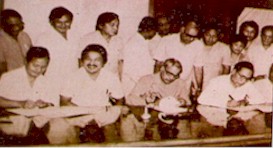
Statehood was a prerequisite to the implementing of the accord singed between the MNF and and the Union Government on 30 June 1986. The document was signed by Laldenga, on the behalf of MNF, and the Union Home Secretary RD Pradhan on behalf of the Government, Lalkhama Chief Secretary of Mizoram, too signed the agreement.
The MNF volunteers came out of their hiding and surrendered arms to makeshift bamboo huts up for the purpose at Parva and Marpara. A total of 614 activists gave themselves up in less than two weeks in July. Large quantities of small and big firearms including LMGs and rifles were received from them.
While the MNF kept its part of the bargain, the Centre initiated efforts to raise the status of Mizoram to a full fledged State. A constitution Amendment Bill and another to confer statehood on Mizoram was passes in the Lok Sabha on 5 August 1986.
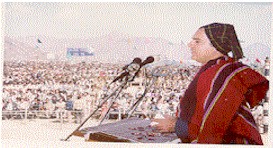
The formalization of Mizoram State took place on 20th February, 1987.Chief Secretary Lalkhama read out the proclamation of statehood at a public meeting organised at Aizawl's Parade Ground. Prime Minister Rajiv Gandhi flew in to Aizawl to inaugurate the new state. Hiteshwar Saikia was appointed as Governor of Mizoram.
PLACE OF INTEREST :
There are quite a number of places in Mizoram which may be described as 'must see' for tourist sports, anyone wishing to see a little more than the conventional tourist sports, anyone interests to know about the local culture and traditions is advised/expected to to do /visit some of the Mizoram's historic memorials and fabled caves scattered all over the State. Traveling in Mizoram, not unlike in any other mountainous regions, is pain staking and little hazardous at times, but it has its own rewards.
Blue Mountain: The Highest peak in Mizoram, The Blue Mountain (Phawngpui) is situated in Chhimtuipui district overlooking the bend of the river Koldyne (Chhimtuipui) close on the state's border with Myanmar. The peak 2,157 metre in height and encircled by bamboo groves at the top where there is a level ground of about 200 hectares, offers a grand view of the height hills and the meandering undulated valleys. The woods around are home to various species of beautiful and rare flora and fauna.
Pukzing Cave: The largest cave in Mizoram, it is situated at Pukzing village near Marpara in the district of Aizawl district (Mamit). Legend has it that cave was carved out of the hills with the help of only a hair pin by a very strong man called Mualzavata
Milu Puk: In the Mizo language, puk means a cave. Situated near Mamte village over 100 kms, from Lunglei town, the Milu Puk, which is a large cave, was found many years ago to contain heaps of human skeleton.
Lamsial Puk: Sitiuated near Farkawn village in Aizawl (Champhai) district, the cave as a silent testimony to a battle between two neighboring villages in which many lost their lives. The bodies of the fighters from village Lamsial are said to have been kept in the cave.
Kungawrhi Puk: Another cave in Aizawl district, it is situated on a hill between Farkawn and Vaphai Villages. According to the folktales, a beautiful young girl by the name of Kungawrhi was abducted and kept confined in the forlorn cave by some evil spirits when she was on her way to her husband's village. Kungawrhi, however, was later rescued by her husband from the prison of the spirits.
Sibuta Lung: Erected about three hundreds years ago by a tribal chief, this memorial stone is named after him. The memorial offer a story of jilted love and lust for revenge. Having been rejected by a girl he fell headlong in love with, Sibuta went mad for revenge and decided to raise a memorial to himself in a manner which displayed an insane mind. A huge rock awash with the blood of three people sacrificed by Sibuta was carried over a distance of 10 km from the Tlawng river. Darlalpuii, a beautiful young girl, was crushed alive in a pit dug to erect the mausoleum. The memorial was raised over Darlai who lost her life under weight of the stone.
Phulpui Grave: A tale of love and tragedy also hangs by this grave located at Phulpui village in Aizawl District. Tualvungi, a raging beauty in her time, was married to Zawlpala, the Phulpui chief. She was later forced by circumstances to marry Phuntia, chief of another village. But Tualvungi could not forget her first love. She came to Phulpui years after Zawlpala's death, hah a pit dug by the side of his grave and persuaded an old woman to kill and bury there.
Chhingpuii Memorial: Raised to the memory of a young woman called Chhingpuii who was exceedingly beautiful, it is situated between Baktawng and Chhingchhip villages on the Aizawl - Lunglei Road. Chhingpuii, born to an aristocratic family, selected Kaptluanga as her husband from among her many suitors. But her happiness was short-lived, as a war broke out afterwards. Chhingpuii was abducted and killed. A grief-stricken Kaptluanga took his own life. The stone memorial reminds one of the legendary love story of Chhingpuii and Kaptluanga.
Mangkhai Lung: A large memorial stone, it was erected about three hundred years ago at Champhai to the memory of a well-known Ralte chief, Mangkhaia.
Budha's Image: An engraved image of Lord Buddha, with those of dancing girls on either side, was found at a site near Mualcheng Village about 50 km from Lunglei town. The site also has another stone slab on which some human footmarks and a few implements like spearhead and Dao are engraved. The area is close to the Chittagong Hill Tracts which was under which the Buddhist influence a few centuries ago. It is assumed that some visiting Buddhists from the Hill Tracts were responsible for the Buddha engraving.
Suangpuilawn Inscriptions: A stone slab lie by a stream at Suangpuilawn village in Aizawl district with strange words inscribed on it. The inscription remain to be deciphered till date. However, it is believed that the inscription were done by some people who inhabited the area in ancient times.
Thangliana Lung: Captian T.H.Lewin was one of the first Englishmen to come to Mizoram. The District Commissioner of the Chittagong Hills Tracts, who entered Mizoram by way of Demagiri (Tlabung) in 1865, became so popular with the local tribesmen that as a mark of respect, he was called Thangliana which meant 'greatly famous'. He lived with the Mizos for nine years and authored the first Lushai book. His memorial stone at Demagiri remains as evidence of the extent of his popularity with the Mizos.
bout Mizoram - > Dances
Mizo people have a number of dances which are accompanied with few musical instrument like the gong and drumKhuallam: Khuallam literary means 'Dance of the Guests'. It is a dance usually performed in the ceremony called 'Khuangchawi'. In order to claim a distinguished place in the society and to have a place in paradise or Pialral one has to attain the coveted title of 'Thangchhuah'. There are two ways of attaining this title. (Video Clip)
| Firstly one could attain the title Thangchhuah by proving one's mettle in war or in hunting by killing many animals which should include animals like barking,deer, wild boar, bear, wild gayal, viper, hawk etc.Secondly one could also get the title of Thangchhuah by performing feats and dances. Thangchhuah therefore could be attained only by the brave or by the rich. The ceremonies performed in the second method are known as Khuangchawi. | | 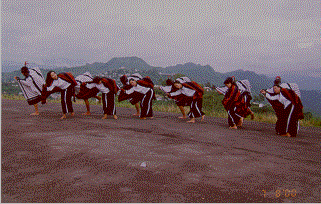 |
Guests invited from the other villages at the Khuangchawi ceremony enter the arena dancing Khuallam. Traditional hand woven Mizo cloth known as Puandum is wrapped over the shoulders and the dance is performed by swaying the cloth. Puandum has the colors black, red, yellow and green stripes. Significantly Puandum is an indispensable item which every girl has to take along with when she gets married. It is used when her husband dies to cover the dead body. As most other folk dances of the Mizos, this dance is accompanied by a set of gongs known as Darbu and no song is sung. It is generally performed in large numbers.
| Cheraw: Cheraw is a very old traditional dance of the Mizos. It is believed that the dance had already existed way back in the 1st Century A.D., while the Mizos were still somewhere in the Yunan Province of China, before their migration into the Chin Hills in the 13th Century A.D., and eventually to the present Mizoram. Some of the tribes living in South East Asia have similar dances in one form or the other with different names. | | 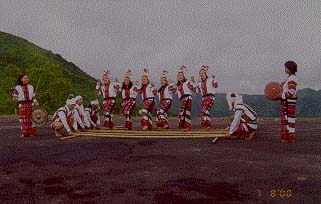 |
| Men sitting face to face on the ground tap long pairs of horizontal and cross bamboo staves open and close in rhythmic beats. Girls in colorful Mizo costumes of 'Puanchei', 'Kawrchei'. Vakiria' and 'Thihna' dance in and out between the beats of bamboo. This dance is now performed in almost all festive occasions. The unique style of the 'Cheraw' is a great fascination everywhere it is performed. Gongs and drums are used to accompany the dance. Today modern music also complements the dance. (Video Clip)Sarlamkai/Solakia : This is an impressive dance originating from the Pawi and Mara communities in the southern part of Mizoram. This dance is known as 'Sarlamkai' whereas the Lushais referred to it as 'Rallu Lam'. In older days when the different tribes were constantly at war with each other, a ceremony to deride the vanquished beheaded skull of the enemy was usually held by the victor. This ceremony is performed to ensure that the vanquished soul remains a slave to the victor even when the latter also dies. |
| The derision ceremony usually lasts for 5(five) days. The first 2 (two) days is spent in merry-making, singing alongside drinks and a non-vegetarian feast. On the third day a pig is slaughtered and he victor paints his whole body with the animal's blood, which he only washes off on the evening of the fourth day or on the morning of the fifth day. During this 5(five) days period, the victor is not to sleep with any women. life. | | 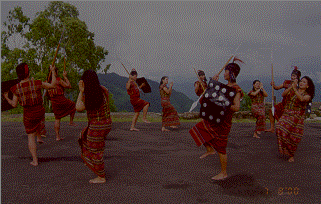 |
| If he does so, the vanquished soul is believed to be infuriated and cause upon the victor, a permanent disability inAny person who brings about an occasion for such a ceremony is highly regarded and respected by the people, the king as well as his elders.Therefore, every adult strives with all his or her capability to be such a hero. The courage and bravery of such heroes is a great consolation for the people when faced with any external aggression. It is during this ceremony that the 'Sarlamkai' dance is performed. As is obvious, it is a warrior dance performed to celebrate a victory in war. Songs are not sung; only gongs or cymbals or drums are used for making beats. In the dance, boys and girls standing in alternate position, dance in circles. They generally wear colorful dresses while the leader is dressed as a warrior.Chailam: Chailam is a popular dance performed on the occasion of 'Chapchar Kut' one of the most important festivals of the Mizos. In this dance, men and women stand alternatively in circles, with the women holding on to the waist of the man, and the man on the women's shoulder. In the middle of the circle are the musicians who play the drums and the mithun's horn. |
| The musician playing the drum choreographs the entire nuances of the dance while the one with the mithun's horn chants the lyrics of the 'chai' song. For the dance to start, the drummer beats on the drum, and upon the fourth stroke of the drum the chai song is sung with the rhythmic swaying of the dancers to the left and right, in accordance with beats of the drum. | | 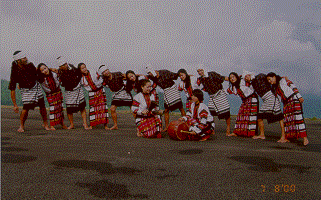 |
| Depending on the nuances followed, the chailam' has four versions, viz 'Chai Lamthai I, 'Chai Lamthai II, Chai Lamthai III and 'Chai Lamthai IV'. Legend has it that once a king and his men went out for hunting. Unfortunately, they failed miserably and had to be contended without a kill. The king, then seeing the utter disappointment of his men, rose to the occasion and consoles them by inviting them for a drink of rice beer at his palace. On being intoxicated by the drinks, the party then culminated by singing and dancing followed by a sumptuous feast. Since then, every year, the community continues to enliven the memory of this occasion be celebrating it with various entertainment programs, thus giving rise to one of the most important festivals of the Mizos, the 'Chapchar Kut'. In this dance, musical instrument like drum and horns of mithun are used for making beats. The festivals continues for a week or more. In olden days, the 'Chai' dancers used to drink rice beer continuously during singing and dancing.Chawnglaizawn : This is a popular fold dance of one of the Mizo communities known as Pawi. This dance is performed in two different occasions. |
(i) It is performed by a husband to mourn the death of his wife. The husband would be continuously performing this dance till he gets tired. Friends and relatives would relieve him and dance on his behalf. This signifies that they mourn with the bereaved.
(ii) Chawnglaizawn' is performed on festivals and also to celebrate trophies brought home by successful hunters. | | 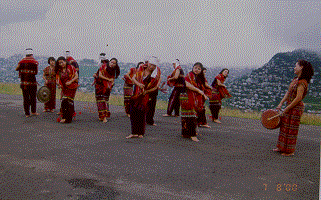 |
| On such occasions, it is performed in groups of large numbers. Boys and girls standing in rows dance to the beat of drums. Shawls are used to help the movement of the arms, which also adds color to the dance. Only drums are used in this dance.Chheihlam : Chheihlam' originated after the year 1900 on the lines of the songs known as 'Puma Zai' and the dance known as 'Tlanglam'. It is a dance that embodies the spirit of joy and exhilaration. It is performed to the accompaniment of a song called 'Chheih hla'. People squat around in a circle on the floor, sing to the beat of a drum or bamboo tube while a pair of dancers stand in the middle, recite the song and dance along with the music. |
| It was a dance performed over a round of rice beer in the cool of the evening. The lyrics are impromptu and spontaneous on the spot compositions recounting their heroic deeds and escapades and they also praise the honored guests present in their midst. While singing the song accompanied by sound produced by beating of the drum or clapping of hands, an expert dancer performs his dance chanting verses with various movements of the body, with limbs | | 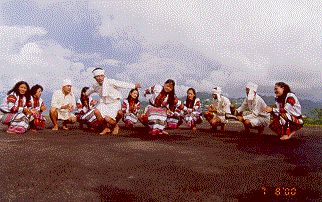 |
| close to the body and crouching low to the ground. As the tempo rose and the excitement increases, people squatting on the floor leave their seats and join him. Guests present are also invited to join the dance. Today 'Chheihlam' is performed on any occasion with colorful costumes, normally in the evening when the day's work is over |
| Tlanglam: Tlanglam is performed throughout the length and breadth of the State. Using music of Puma Zai, there have been several variations of the dance. This dance is one of the most popular dances these days by our cultural troupes in various places. Both sexes take part in this dance. | | 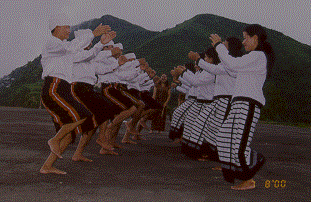 |
Zangtalam: Zangtalam is a popular Paihte dance performed by men and women. While dancing, the dancers sing responsive song. A drummer is a leader and director of the dance. The duration of the dance depends on the drummer.
About Mizoram->Physiography
Hills: Mizoram is a land of rolling hills, rivers and lakes. As many as 21 major hills ranges or peaks of different heights run through the length and breadth of the state with the highest peak 'Phawngpui (Blue Mountain) towering 2,065 metres above the sea level. The terrain has, perhaps, the most variegated topography among all hilly areas in this part of the country. The hills are extremely rugged and sleep and the ranges and leaving some plains scattered occasionally here and there. (more info)
Rivers: Although many rivers and streamlets drain the hill ranges the most important and useful rivers are the Tlawng (also known as Dhaleswari or Katakhal), Tut (Gutur), Tuirial (Sonai) and Tuivawl which flow through the northern territory and eventually join river Barak in Cachar.The Koldoyne (Chhimtuipui) which originates in Myanmar, is an important river in the south Mizoram. It has four tributaries and the river is in patches. The Western part is drained by Karnaphuli (Khawthlang tuipui) and its tributaries. A number of important towns including Chittagong in Bangladesh is situated at the mouth of the river. Before Independence, access to other parts of the country was possible only through the river routes via Cachar in the north, and via Chittagong in the South. Entry through the later was sealed when the Sub-continents was partitioned and ceded to E.Pakistan (now Bangladesh) in 1947. (more info)
Lakes: Lakes are scattered all over the state. But the most important of them are Palak, Tamdil, Rungdil; and Rengdil. The Palak lake is situated in Chhimtuipui District in southern Mizoram and covers an area of 30 Ha. It is believed the lake was created as a result of an earthquake or a flood. The local people believe a village which was submerged still remains intact deep under the waters.
The Tamdil lake is a natural lake situated 110/85 kms from Aizawl. Legend has it there was once a huge mustard plant in this place. When the plant was cut off, jets of water sprayed from the plant created a pool of water, and thus the name Tamdil which means of 'Lake of Mustard Plant' was born. Today the lake is an important tourist attraction and a holiday resort
bout Mizoram ->Photo Gallery
|
|
|
|
|
|
|
|
Ministry of Communication & Information Technology
National Informatics Centre, Mizoram State Centre
Annex-II, Civil Secretariat, Aizawl - 796001
|
|
|
|
Ministry of Communication & Information Technology
National Informatics Centre, Mizoram State Centre
Annex-II, Civil Secretariat, Aizawl - 796001
|
|
|
|
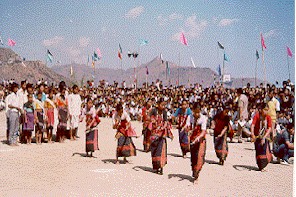


No comments:
Post a Comment